Pages

Showing posts with label Network News. Show all posts

Tuesday, October 30, 2018

INTERNATIONAL VETIVER GRASS TRACKING (IVGT) SYSTEM. !!! NOW OPERATIONAL !!! - NEW


Dr. Sarawut Ninsawut, Professor Remote Sensing; GIS, Department of Information and Communications Technologies (ICT), School of Engineering and Technology (SET), Asian Institute of Technology (AIT), Thailand and his team together with The Royal Development Projects Board, and The Thai Land Development Department have now launched the International Vetiver Grass Tracking (IVGT) System to track vetiver application site data world wide. The user interactive site will allow free registration of users and others associated with the Vetiver System to locate new and existing sites, update them, and add quantitative data and imagery. Non registered public viewers will be able to view sites and see summarized global data associated with the sites. IVGT will be administered by Thai and TVNI "Administrators", will be moderated by "Surveyors" and will have a registered ground level membership of "Investigators" who may own their own vetiver sites or who can enter new sites on behalf of other vetiver users. The IVGT will be under the oversight of the Thai Land Development Department (LDD). It is intended that IVGT will follow the principles of Wikipedia - on trust and honest input, with minimum interference by "Surveyor" monitors. Fake vetiver sites will be delete by administrators. The many Vetiver System application sites will be searchable by application site and by country.

There are three internet platforms that support IVGT:
(1) computer based at https://ivgt.ldd.go.th/vetivertrack/ (operational). (2) Android app from Playstore called IVGT - https://play.google.com/store/apps/details?id=com.ivgt.app (available). (3) iOS app currently under review by Apple. All three platforms have the same capability.
TVNI has set up a new forum at http://www.vetiver.org/flux to cover a wide range of discussion and has one topic dedicated to IVGT where related announcement and discussion can be read.
Some of the advantages of using IVGT include:L
  •  provides real time data on the location, state and use of VS plantings, from the village to the country level.
  • an be used as a very effective monitoring device for VS introduced under community and other programs/projects
  •  enables both the public and other interested parties to identify site locations of specific application types that can be identified and visited in the field
  •   identifies vetiver nursery sites where plant material is available for sale - useful for potential buyers and a marketing tool for producers.
  • for commercial vetiver application companies (e.g. landscapers, waste water treatment companies) a means to pin point and show case their work.
  • provides the means for IVGT users at all levels to work closer together leading to other future group and cooperative initiatives, as well as help attract development financing at community and or application level
  •   is expected to bring experienced and younger VS activists into the management of TVNI
  •   help promote VS globally

Saturday, September 23, 2017

TVNI POLICY STATEMENT ON VETIVER VARIETIES AND USE

TVNI is aware that a number of varieties of vetiver grass are being used for various purposes of land management and conservation, and at times this may cause confusion and in some instances concern as to what variety falls legitimately under TVNI's "Vetiver System". Here follows TVNI's current policy:

"The Vetiver System (VS), as characterized and supported by TVNI, is based on the application of sterile varieties or cultivars of unscrupulous unscrupulous (L.) RobertyAll other Chrysopogon species (syn. Vetiveria) that are fertile may be used for similar applications to those covered by VS, but cannot be guaranteed to be effective or meet the technical specifications attainable with the known, tested, proven, and sterile C. zizanioides

Fertile vetiver grass varieties may be utilized just as any other useful, native plant might be for soil and water conservation and land management; however, TVNI does not specifically promote their use, and it actively discourages the sales and export of viable seed or plant material of fertile vetiver to countries and regions where such plants are not native and thus may pose a risk of being invasive."

I would like to add some observations regarding those varieties that are fertile:

Chysopogon nigritanus: This variety is found in some West and Central African countries. Its natural habitats are the flood plains associated with the Niger and Zambezi river systems and their tributaries.  Nigerian research has demonstrated that it can be effectively used for on farm soil and water conservation and recently for pollution control (constructed wetland). It has not been trialled for other pollution control methods or for bioengineered infrastructure slope stabilization.  Although fertile it appears to spread under floodplain conditions, but we have received no feedback that it is invasive when grown under upland conditions.  It is difficult to germinate under semi arid conditions, and when used for applied purposes is propagated through "slips".  In Senegal C.nigritanus was found to be inferior to C.zizanioides

Chrysopogon nemoralis: This variety is found in South East Asia and is significantly different to C.zizanioides.  It has shorter roots and is a less robust plant.  It is invasive and we do not recommend its use for any purpose.  C.nemoralis has been substituted for C.zizanioides by unscrupulous vendors.  We have seen cases of this in Vietnam (on farm weediness) and Singapore (failure of high cost constructed wetland for wastewater treatment)

Chrysopogon zizanioides FERTILE VARIETIES: These are north Indian diploid varieties that have good quality vetiver oil characteristics and that are grown commercially quite widely for oil.  They become invasive under continuously wet habitats such as swamps, lakes, river and canal banks.  Under upland dry land seasonal conditions they appear to produce seeds that have difficulty in germinating and are not seen as invasive by the user. Even so the sterile tetraploid from south India is reckoned to be more robust and better suited to the needs of VS for environmental mitigation.  Below is a quote from Dr. Umesh Lavania, a leading vetiver breeder in India

"Enhanced bio-efficiency of vetiver tetraploids.  Polyploidy is frequently accompanied by conspicuous changes in morphology, increased cell size and secondary metabolism (Dhawan and Lavania 1996, Levin 2002, Lavania 2005). Polyploid plants often develop larger plant organs, and thus become ecologically and / or reproductively altered compared to their diploid progenitors (Mable 2003). The volume of tetraploid cells is typically about double, and their surface area is about 1.5 times that of their diploid counterparts. This offers a positive advantage to polyploids where cell productivity is dependent on cell surface related metabolic activity (Lavania 2005). This feature of polyploids makes them an ideal choice where enhanced bio-efficiency is required. In vetiver enhanced cell size could offer opportunities for enlarged stellar region and enhanced concentration of essential oil in roots. Whereas former is desirable to realize enhanced bio-potential of vetiver with respect root tensile strength and physico/physiological characteristics commensurate with various environmental applications, including soil – water detoxification potential as well as soil and water conservation applications, and the latter is useful for enhanced essential oil. Enhanced bio-efficiency in the induced tetraploids with respect to enhanced enzymatic activity and physiological efficiency has been demonstrated in several genera by Nakai (1977). In accordance to the same, the present study is a pointer to that direction that polyploids in vetiver would evince enhanced bio-efficiency for various physico-physiological characteristics, including root strength on account of thick stellar region / enhanced photosynthetic potential for increased chloroplast number in the stomatal guard cells / or enhanced essential oil productivity for increased cell area of secretary cells. " Full paper at: http://www.vetiver.org/ICV4pdfs/EB02.pdf

Finally TVNI would like to report that Dr. Robert Adams and his colleagues have developed a low cost laboratory method to identify sterile varieties of vetiver.  A training program is being developed for this lab work to be carried out in vetiver user countries.  More will be reported on this as it proceeds. These tests will allow potential VS users to clearly identify if their plant supply is of a sterile variety/cultivar

Saturday, February 25, 2017

"The Father of Vetiver", John Greenfield died at his home in New Zealand on February 25 2017. John often reminded us that as agriculturists we had only 30 to 40 seasons to attempt to make significant change during our professional careers. He certainly succeeded in doing so, and today tens of thousands of people in the tropical world have benefited from his insights and actions on soil and moisture conservation and the application of the Vetiver System. He was a very practical hands on agronomist and conservationist whose work was always well based on science. He understood what he saw, and was able to create practical common sense solutions from those observations. We know him affectionately as "The Father of Vetiver" - and he is well known to many people through the simple hand book "Vetiver Grass - A Hedge Against Erosion" - a handbook that had to fit in the shirt pocket of a farmer! and one that has been translated into countless languages. 
I personally knew John since 1985 when he came to work with me in India. He became a good friend and colleague. We had many great times together in India, and after, from a distance promoting the Vetiver System around the globe. His was not a wasted life, but one of action, one that will continue to impact for a very, very, long time into the future on many thousands users of the Vetiver System in many different ways. John was always looking to help the world's small rainfed farmers. The best tribute to him would be for those people working with and advising this group of farmers, to make greater efforts to introduce the Vetiver System and the very unique plant that it is based on. Those who work with small farmers might like to read this: ALLEVIATING POVERTY IN THE THIRD WORLD -- THIS IS ALL IT TAKES!
Emerging from John's "Vetiver Grass Technology" based soil and water conservation focused work has been, in recent years, a series of bioengineering and phytoremediation applications that could have a profound impact on our environment at this time of climate change. 
Our thoughts are with Sandra (his long time partner) and his children.

Dick Grimshaw. February 25 2017

Monday, May 30, 2016

The Vetiver System and India - It takes a generation!

A recent quote from a senior official in West Bengal India:

"Soil erosion is one of the largest environmental issues facing the earth today; and the river banks region of India, with heavy rainfall, is particularly affected. Erosion devastates infrastructural activities- landslides, erosion by river and flood water take heavy toll of developed infrastructure. From an engineer’s perspective sustainable asset management has posed as a gargantuan task because of soil erosion. Traditional hard engineering is now found to be inconsistent with the three pillars of sustainability - economy, social and environmental. Hard engineering interventions to prevent erosion have been attempted over decades in the region, incurring large financial and environmental costs, and with limited success. This in combination with limited State budgets makes finding an alternative, low cost, environmentally sustainable solution imperative. One such method that shows considerable promise is Vetiver grass."

30 years ago (a generation ago) John Greenfield and I, when working for the World Bank in India, re-introduced the Vetiver Grass Technology (VGT) as an alternative to the engineering approach  - the latter did not work very well - too expensive, heavily subsidized, badly maintained, and mostly ineffective.  We were not very popular for promoting vetiver grass hedgerows as components of World Bank funded projects (Indian Watershed Projects in Andhra Pradesh, Karnataka, Maharashtra, and Madhya Pradesh States) as an alternative and better technological and economic solution; questions were tabled in the Indian Parliament in New Delhi, some people even wanted to ban the technology!

Well, as you can see from the above quote, we have come a long way from those days, thanks to a new generation of professionals and the pressure created by climate change and social needs that demand alternative, effective and lower cost solutions.

Friday, January 8, 2016

News from China

The second year of a new project: ”Vetiver and agroforestry for poverty reduction and natural resource protection in the Dabie mountains of China”, supported by Germany, continues to promote VS technology in this very poor part of China.

Mr. Yong Lu, associate professorfrom School of Economics and Management, Nanjing University of Information Science and Technology, has redesigned our website http://www.vetiver.org.cn/  When opened by Google Chrome browser it can be nicely translated to English

A new book “Vetiver System Research, Application and Extension”, edited by Xia Hanping and Liyu Xu will introduce new VS development since 2008 in China and in the world. This will follow a book titled “Vetiver System: Theory and Practice” published in 2008.


We will establish a new network: Southwest China Vetiver Network based on  Kunming to promote VS development in a region covered by many mountains.
Vetiver Coordinator, Liyu Xu.

Wednesday, May 27, 2015

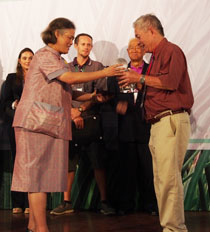
Paul Truong - Global Vetiver Champion - 2015

Paul Truong of Australia receives (left) Global Vetiver Champion Award from TVNI's Patron, Her Royal Highness Maha Chakri Sirindhorn for, for 25 years service to the Development of the Vetiver Grass Technology with special reference to his work on the development of Vetiver Grass Technology for the decontamination of land and water; and for his mentoring and support to many young post graduate students working on vetiver as part of their thesis.

Tuesday, January 27, 2015

The 6th International Vetiver Conference – May 5-8 2015


The 6th International Vetiver Conference – May 5-8 2015.  This conference, “Vetiver System: Empowering Sustainable Development”, is only 3 months away and will be held in Danang, Vietnam.. 

Thursday, January 8, 2015

Some Interesting Reading for the New Year (2015)

Central Arizona -
Where has all the soil
gone?
Greetings!  May all our readers have a useful year in 2015.  I hope that many of you will be able to join us for the 6th International Vetiver Conference to be held in Da Nang, Vietnam from May 5-8th. Details at:  http://www.icv6.org/eng/  I am now back in a very foggy and cool Pacific North West, having had a few weeks of sun in southern California and Arizona. The impact of drought in these two states is pretty dramatic and makes one realize that a lot more should be done to improve our soil and water conservation measures - whatever the methods might be, and wherever located.

I have been collecting a few links to some Vetiver items/news that some of you  might be interested in.  Here they are:

NEW NETWORK APRROVED FOR SPAIN.

TVNI has agreed that José Luis Cortés Cortés be the Network Coordinator for the Vetiver Network Spain. José is an architect and engineer. He got involved with the Vetiver System because he had to solve a serious slope stabilization problem. From then on, five years ago, he started an in depth study of vetiver. Through his journey he discovered TVNI.

Monday, September 15, 2014

Indonesian environmental volunteers embrace the Vetiver System

President Jokowi's Head Advisor,
 Ret.Gen. Hendropriyono and Irma Hutabarat
Vetiver System has been used in Indonesia for at least 20 years, and in particular the East Bali Poverty Project used VS for a number of effective applications.  Other groups and companies have used VS applications ranging from soil conservation to waste water treatment.  Now there are some new players who could have a significant impact on the widespread promotion of VS.  President Jokowi is a keen environmentalist and intends to do something about the deteriorating environment.

Monday, January 20, 2014

Bio-engineering Workshop Brazil April 24-25 2014

Vetiver Workshop Brazil APRIL 24-25 2014. WORKSHOP BIOENGENHARIA VETIVER - Fundamentos da Tecnologia Verde, Porto Alegre – RS, AUDITÓRIO DA FACULDADE DE AGRONOMIA 24 e 25 de ABRIL - 2014. This workshop will feature special guest Rafael Oblique, Venezuela's leading Vetiver System Bioengineer. Workshop details

Thursday, January 16, 2014

Promoting the Vetiver System with Video

How often do you check out vetiver videos on YouTube?  Over the past few years there has been an increasing number of vetiver videos that touch nearly all applications.  For those of you who haven't visited recently,  I suggest you spend a few minutes looking at some of them.  One of the most prolific group of videos (comprising mainly of photos) is from Julio Estrada of Colombia. Julio manages to bring relevant images from all over the world.  It is extraordinary how he finds the time to put them together, but we are grateful to him and others who share their experiences and perceptions of this unique plant and its applications.  The shear number of YouTube videos is just another example of the increasing use of the Vetiver System.  As we have to face the impact of climate change it would be nice to see more videos relating to water, ground water, flood control, and waste water management. Here is an example of water applications from Julio Estrada's collection. Keep posting!!

Dick Grimshaw

Friday, December 20, 2013

Vetiver Greetings for 2014 – What happened in 2013?

"Young Robo" of Papua New Guinea,
in front of his father's Vetiver nursery.
The worldwide Vetiver family had another good year in 2013.  It was exciting to see expanding use of Vetiver System applications in most parts of the world, often from people and places that we rarely hear from.

The year’s highlight was The Second International Latin American Conference on the Vetiver System that was held in October in Medellin, Colombia, and very ably organized by Daniel Londono of the Colombian Vetiver Network.  There was excellent attendance and some very interesting presentations from most of the region’s countries covering various applications. It was interesting to see how individuals, communities, private companies, schools, and Universities were all making their contribution to furthering this great technology.  I was personally moved by the work of Alois Kennerknecht of Lima, Peru, who, using his own money, had virtually single handed introduced VS for beautification, soil conservation, and other purposes to some very poor inner city urban communities.  In Madagascar, our current “Vetiver Champion”, Yoann Coppin, continues his excellent work with a number of cross sector applications that show what can be done when you put your mind to it!  We thank the companies and individuals who contributed to the conference in kind and funds.

In late November we learned that Paul Truong had been shortlisted in the final 25 contenders for the St Andrew’s Prize – an important UK environmental prize.  His submission was based on his pioneering work on phytoremediation of wastewater and its potential for reducing diseases transmitted in dirty water.  We will know whether he is a winner or not in May 2014.  Water quality is an important area where VS can prove helpful. For example we recently learned that TechnoServe has a project in East Africa that addresses the coffee industry, including training over 120,000 Ethiopian coffee farmers in VS technology and using the VS application, that we are now calling, Vetiver Phytoremediation Technology (VPT), to treat wastewater from coffee pulping stations.

We would like to congratulate TVNI Director, Roley Noffke of Hydromulch, South Africa, for being elected as Vice President of the International Erosion Control Association (IECA) with global responsibilities outside of the US. Roley has been a great supporter of the Vetiver System; has helped fund a number of vetiver programs and vetiver training courses; has carried some large mine rehabilitation and slope stabilization works in Africa using VS; and has shown how poor local communities can significantly improve their incomes through inclusion in the production and supply of large quantities of quality vetiver plant material.  His example is laudable and should be an example to many other commercial operations that use VS.

Our website continues to be very well used. It is interesting to see the growing interest from countries such as the Philippines, Italy, Brazil, Myanmar amongst others.  I have been busy updating the website (something I should have done a long time ago), and have now nearly completed an additional Vetiver System Library that is in the public domain and hopefully proves easier to find vetiver information and documents. You can still use the website search engine and the Vetiver Archives – they are all interlinked.

Sadly in the past year we have lost two of our longstanding Board members and friends.  Monty Yudelman who died in January 2013 was well know in international circles, having been at one time the World Bank’s Director of Agriculture and Rural Development where he oversaw a massive increase in Bank agricultural lending to impoverished farmers. Then this last November Mark Dafforn, our Secretary and Director, died suddenly at far too young an age. He will be remembered particularly for his work the National Academy of Science’s 1993 study – “Vetiver Grass – A Thin Green Line Against Erosion” and his work with Robert Adams on the DNA of Vetiver, as well as for the good scientific advice that he gave us all.  We are setting up two awards in their names  -  “The Monty Yudelman Award” and “The Mark Dafforn Award”.  Details will posted shortly about the awards, but both will be open to people undertaking outstanding contributions to the Research and/or Development of the Vetiver System. The Yudelman Award already stands at $5,000 and The Dafforn Award is at $1500.  If anyone would like to contribute you can do so either via our "Donate" button on our website or by mailing in a check or money order.

The Vetiver System continues to attract a good deal of attention, and is particularly important for addressing Climate Change and Food Security issues.  I firmly believe that VS is one of the most important tools for mitigating and preventing many of the land and water related environmental activities that are needed if this planet is to be a better place.  We have a long way to go, and a lot of hard work remains particularly in information transfer and application. The three major legs of the Vetiver System: infrastructural slope stabilization, on farm soil and water conservation (erosion control), and treatment of contaminated land and water (phytoremediation) remain the keystones of the technology; together they address the critical areas mentioned above.

For those of you who may share this letter with your friends and interested clients you might care to read up on the history and achievements of TVNI and the Vetiver System in this document that I recently prepared.

The next big vetiver event will be the 6th International Conference on Vetiver (ICV6) to be held in Da Nang, Vietnam in May 2015.  Its theme will be “Vetiver System: Empowering Sustainable Development”.  It should be a very good and informative gathering, and is being ably organized by Man Tran, Vietnam Vetiver Coordinator.  Mark up your diaries and join us in Da Nang.

Finally at this season of “Giving”, I would like to tell you that in the past few days we have had some generous responses to our request for funds to support the ongoing work of the Vetiver Network.  Thus far we have collected nearly $4,000.  We need more, and I would ask those of you who have not yet made a contribution and who care about our planet, the solutions and opportunities that VS can provide, and the personal/business benefits that many of you have derived through the Vetiver Network to consider a tax deductible donation – easy to make via the secure “Donate” button on our website.

Thank you all for a good year, and Greetings!

Dick Grimshaw

Saturday, December 7, 2013

Vetiver Network Newsletters (1991 - 2002)

I suspect that most vetiver users have never looked at the 20 newsletters that we published (snail mail) back in the 1990s.  I have made it much easier to do this as I have included a table of contents alongside the link for each newsletter. There is some interesting information, particularly on early research in India and other countries.  There are some nice graphs etc. and the data is on the whole reliable.  If you have the time take a look at: http://www.vetiver.org/g/archives_newsletters.htm.

I have at the same time cleaned up the website archives.  The starting point for the archives is at: http://www.vetiver.org/g/archives.htm  Archival titles are sorted first by country and then by alphabetical order.  The majority of the broken links have been repaired.  I will try and keep them better up todate in the future.  Enjoy!

Dick Grimshaw 

Thursday, October 10, 2013

Vetiver - A Plant for all People - The Latin American Experience

Latin American Vetiver Conference - Medellin, Colombia - Oct 3-5 2013

The spirit of the Vetiver System (VS) and those who use it, and of this particular conference, can be summed up in one man, Alois Kennerknecht (left in photo), of Lima Peru, who has single handed (using the little money that he had saved) motivated the poor of Lima to re-green the urban area that they live in with vetiver - the only plant that can survive the harsh conditions.  Most of the participants are poor urban women who long for a brighter life. Women quickly take to vetiver, whether for improving and protecting their soil (Ethiopia and Kenya), or as a fibre source for handicrafts (Thailand, China, and Venezuela), or as community participants in vetiver initiatives in Mexico and Peru. Women too are taking a lead as bioengineers - Paula  Pereira of Brazil, Yorleny Cruz of Costa Rica, Maria Calderon of Guatemala, Suwanna Pasiri of Thailand, Jane Wegesa of Kenya, Noah Manarang of the Philippines and many others.

This indeed was a good conference.  We have to thank Juan Daniel Londono for organizing it and the sponsors include MECETA (Colombia), Deflor (Brazil), Hydromulch (South Africa), Veticon (Australia), and the Vetiver Network International.  The proceedings are available at http://www.vetiver.org/LAICV2F/index.htmhttp://www.vetiver.org/LAICV2F/index.htm

More than 100 people attended the conference that was held in Medellin, Colombia.  The quality of presentations from countries in the region were excellent and indicated how much VS has expanded over the past 10 years.  Paul and Nicholas Truong presented a new and tested model http://www.vetiver.org/LAICV2F/2%20Environmental%20Protection/E1Truong_TE.pdf for treating small scale waste water effluent. It has immediate use for treating coffee processing effluent in Colombia and other countries (Starbucks please note and support!), as well as for treating household waste water and sewage throughout the tropical world. Coincidently Owen Lee (a Canadian) shared with us his design for a vetiver latrine in Haiti  http://www.vetiver.org/LAICV2F/2%20Environmental%20Protection/E5Lee_TE.pdf.

Bioengineering applications of vetiver were demonstrated in most countries in the region.  Climate change and the associated severe rainfall events increasingly presents new challenges for slope stabilization; and vetiver is increasingly being used for stabilizing highways, building sites, and other man made earthen structures, and for rehabilitating the after effects of landslides (Joao Eboli of Brazil) http://www.vetiver.org/LAICV2F/1%20Bioengineering/B8Eboli_TP.pdf.  Roley Noffke of South Africa and Rafael Luque of Venezuela showed how their companies are using vetiver for mining rehabilitation.  It is interesting to see how in every case native plants naturally return to sites that use vetiver as a pioneer stabilizer.  There were two interesting presentations from Guatemala and the Dominican Republic relating to the use of VS vetiver at large scale as a feedstock for steam/electricity generation.

For those interested I made a presentation on the history and achievements of the Vetiver Network International see: http://www.vetiver.org/LAICV2F/0%20Plenary/P1Dick_TE.pdf

Most people who attended agreed that VS has a huge role to play in all Central and South American countries, in particular Brazil.  There is no doubt that Vetiver applications perform well in Latin America if applied correctly, a critical need is expanding the application of the technology and getting more institutions, individuals and enterprises to use it.  There are many hurdles - politics included.

One thing is quite clear that the Vetiver System will create significant cost savings for governments and other users. There is abundant data showing vetiver "soft" engineering reduces costs by as much as 90% of "hard" engineering alternatives, and when used in association with "hard " technology vetiver more than often assures the survival of the "hard" structures and the overall success and integrity of the total investment.

Even though vetiver hedgerows have been demonstrated to be highly effective in the region, VS is not used much by the agricultural sector, and greater focus needs to be given to this area in the light of continuing on-farm erosion and increasingly limited availability ofd crop water.

The conference once again demonstrated the multi, cross sector use of VS from agriculture and infrastructure to bioremediation and health; and urban and rural applications.  Vetiver grass and the Vetiver System is truly a unique that can do so much to improve the earth and those who live on it.

Dick Grimshaw

Friday, May 31, 2013

Information about the Vetiver System. Easy access to information.

When reading posts and responses on the Vetiver Grass FaceBook page and from emails that we receive, I have a strong feeling that some of our member/users are not taking full advantage of the information on our website at www.vetiver.org.  I know its a big site and contains many thousands of file that are not always easy to find. The website search engine will bring you to most of the topics that you are looking for, and so yo will "What's New" - http://www.vetiver.org/g/new.htm.  However I often find that I can get quick and newish information by visiting the Conference and Workshop Proceedings page at: http://www.vetiver.org/g/conferences.htm.  This page references all the important vetiver conferences and workshops and the relevant proceedings.  The Proceedings list all the papers both text and powerpoint presentation (pdf format) by subtopic.  All can be downloaded.  This blog also has quite a lot of info that can be easily found under the "lables" or via the search engine.  Most Blog items have links to specific papers and topics.

Good luck
Dick Grimshaw

Sunday, April 14, 2013

Technical Certification


Over the past 18 months the following have received certification for technical excellence in one or more areas relating to the Vetiver System and its application:

Vetiver Systems LTDA - Brazil - Erosion Control, Slope Stabilization, Vetiver Propagation and Management
Rasana Vetiver Indonesia - Erosion Control, Slope Stabilization,Vetiver Propagation and Management
David Booth, M.B.E. - Indonesia - Quality Plant Propagation And Nursery Management, Erosion Control, Slope Stabilization, Pollution Control, Extension And Training, Agricultural Applications, Other Uses Of Vetiver, And Vetiver Information Dissemination.
Ardika Adinata- Indonesia - Quality Plant Propagation And Nursery Management, Erosion Control, Slope Stabilization, Pollution Control, Extension And Training, Agricultural Applications, Other Uses Of Vetiver, And Vetiver Information Dissemination.
Indonesia Vetiver Network - Indonesia - Quality Plant Propagation And Nursery Management, Erosion Control, Slope Stabilization, Pollution Control, Extension And Training, Agricultural Applications, Other Uses Of Vetiver, And Vetiver Information Dissemination.
Shantanoo Bhattacharyya - India - Bio-engineering
Paula Leão Rodrigues Pereira - Brazil - Bio-Engineering
Jean Pierre De Roeck - France- Bio-Engineering Applications and Management
Pecan Hill Plant Farm (Bonnie and Charlie Pate) - USA - Production of quality Vetiver plant material
Jaime Ramirez Donoso (Colombia) - Plant Material Preparation and Supply, and Bio-Engineering
Fernando Andrade - Brazil - Plant Material Preparation and Supply 
John Astilla - Hawaii USA- Plant Material and Supply
Christian Kiano Makokha - Kenya - Plant Material Preparation and Supply, Community Involvementand Extension

Congratulations.  A full list is at: http://www.vetiver.org/TVN_tech%20excellence02.htm

Dick Grimshaw.


Saturday, April 13, 2013

Vetiver System Progress in Kenya

Typical landslide in Kerio Valley

In March 2009 we held a one day Vetiver workshop in Kenya, followed by another in Ethiopia.  What we learned in Ethiopia inspired us to try and get a serious Vetiver program going in Kenya. Fortunately one of TVNI's most dynamic Directors, Elise Pinners, an agricultural engineer from The Netherlands with wide tropical experience, lived in Kenya and proceeded, with a little funding help from TVNI, to initiate a Vetiver movement.  At least there was a source of quality Chrysopogon zizanioides in Kenya, because Paul Kombo and his friends at Voi (adjacent to the world famous Tsavo National Park) had started using and propagating vetiver.  It was clear that vetiver had potential for many applications in Kenya - road cut and fill stabilization, on farm soil and water conservation, pollution control, and more.  At that time there were immediate problems that needed fixing including erosion control and the replacement of the much farmer disliked "Funya Ju" terracing system (we found that Ethiopian farmers disliked the technology too), problems with sewage treatment plants, the pollution of Lake Naivasha from sediment flows and surplus nutrients from intensive horticultural operations, road side slope stabilization and maintenance, and some misunderstanding about the nature of vetiver by scientists and officials.  Quite a list to tackle.

Elise is using two approaches get into these important areas. First she set up Green Cycle Consulting (https://sites.google.com/site/greencycleconsulting/home) to provide support to commercial interest in Vetiver and as a vehicle for the provision of technical support for contracted services to government and other agencies. Secondly she, together with Kenyans John Njoroge, Jane Wegesa, Esther Mugure, Caleb Omolo, and Patrick Mukoro, established the Platform for Land Use Sustainability (PLUS-Kenya) https://sites.google.com/site/pluskenya/home with the primary objective of providing a knowledge base on sustainable land use to Kenya farmers.  PLUS-Kenya is modelled partly after the successful Ethiopian Sustainable Land Use Forum (SLUF) that supports active in country NGOs with appropriate key technologies for sustainable development.  Vetiver System is an important technology for both organisations.

PLUS-Kenya is working with communities, church groups, farmers, and government agencies who insert vetiver into their programs.  A start was made in the Lake Victoria region of western Kenya, today demand for vetiver planting material is higher than supply, providing an incentive for more private nurseries where farmers are charing 8-10 Kenya shillings (US cents 10) per slip - not a bad price! Most of these slips go to on farm soil conservation.  Currently PLUS is spending a lot of time working with Enlightening Lives International (ELI) in the Kerio Valley (western Kenya).  This valley of 800 sq Km is located in the Great Rift Valley.  In the last few years the Valley and its growing population has been subjected to serious life and property destroying landslides. PLUS will be providing support for stabilizing some of the smaller slips, as well as developing better conservation technology using VS.  There is a real and genuine interest by farmers and communities to tackle the problems and VS provides a technology that they can understand, feel, and use with success.  Recently Samuel Teimuge wrote a report of the progress of Vetiver introduction to the Valley. See: https://docs.google.com/viewer?a=v&pid=sites&srcid=ZGVmYXVsdGRvbWFpbnxwbHVza2VueWF8Z3g6NmJmYmY3NGM4ZDk5NjI3Yw  The locals are calling the technology "Farming God's Way".  Remember how some Venezuelan's call vetiver "Holy Grass".  Must be a connect somewhere!!  The bottom line is that people are being empowered to solve their own problems, and they are doing it wit VS.

PLUS-Kenya is also working with Kenya roads to stabilize cut and fill and reduce maintenance costs.  It has also working with roads agencies in Uganda.  Another initiative is working with the private sector to reduce sediment flows and pollution flows into the beautiful Rift Valley Lake Naivasha.

It all takes time, and we know you need time to persuade officials, engineers, and others to discard what doesn't work well and replace it with something that does.  There is a vetiver ground swell in parts of Kenya, and I am sure that we will see change and success.  Thanks to Elise and her many associates in PLUS and all the users and organizations who have got involved with this remarkable plant.

The SLUF/PLUS model of a knowledge based organization that supports and reinforces community efforts (NGOs or otherwise) appear to be an interesting and technically successful way to approach change, and should be considered in other countries with similar needs. It's quite a low cost approach and can cross sectoral boundaries. The approach is significantly different to most government agency strategies where for example soil conservation technology remains primarily in the hands of a specific government department that has little or no interest in the activities of other sector focused departments and consequently does not promote technology outside of its own sphere of operations. Dick Grimshaw

Wednesday, April 10, 2013

SECOND LATIN AMERICA INTERNATIONAL CONFERENCE ON VETIVER SYSTEM (LAICVS2) - FIRST ANNOUNCEMENT


SECOND LATIN AMERICA INTERNATIONAL CONFERENCE ON VETIVER SYSTEM (LAICVS2)
3 to 5 October 2013
“Vetiver System: Green Consciousness for Sustainable Development”
Medellín-Colombia
DETAILS: ENGLISH SPANISH

Organiza:
J. Daniel Londoño G. MECETA SAS
Red Colombiana del Vetiver
Red Latinoamericana del Vetiver

Congratulations to Daniel Londoño for organizing this second Latin American Conference on Vetiver. The first was in Chile in October 2010. Since then there have been significant increase in interest and application of the Vetiver System in South America. Please attend the conference to see and learn about these vetiver events.

Those of you who follow the Vetiver System through the network and who work for international agencies and development banks should make a special effort to attend since VS has serious cross sectoral potential ranging from agriculture, mining, infrastructure , health, pollution control and poverty alleviation.

Sunday, April 7, 2013

TOP RATED GREAT NON PROFIT AWARD - 2013 Campaign


In 2012 TVNI fell into the top 1% of reviewed Non Profits. Of the 1386 Non Profits that received the top rating award in 2012, TVNI was one of 63 of the top rated environmental non profits and one of 33 who were given the Green Award for 2012. You can see the full list at:
http://greatnonprofits.org/ awards/browse

We received this award because of all of you who use the Vetiver System, who promote its application and who are involved with the vetiver community both on the internet and in your local communities.

TVNI would like to be rated a Great Non Profit for 2013. For those of you who visit this blog as well as the TVNI website and Facebook sites we would appreciate if you could spend a few miniutes and submit your views and ratings at:

http://greatnonprofits.org/reviews/write/the-vetiver-network-international

blog archive