Pages

Showing posts with label plant. Show all posts

Tuesday, January 26, 2021

Sharing Vetiver Projects on iNaturalist -- NEW PROJECT

Goals of The Vetiver Network International (TVNI) include creating a worldwide community of vetiver enthusiasts, raising awareness about the many benefits, and tracking vetiver projects. Our facebook group has become a wonderful resource for many of you and we are proud of the community it has created. We had concerns about the preservation of the facebook posts and important discussions, so we also created the vetiver forum (https://www.vetiver.org/flux/).

However, neither of those help us track and map vetiver plantings. To provide a tracking method, we started using the iVGT website created in Thailand to add as many vetiver sites as possible, but it has had some technical difficulties and participation hasn’t been as high as we had hoped. We recently realized there may be a better and much more user-friendly website that we can all use.

iNaturalist (https://www.inaturalist.org/) is a website and smartphone app for people to share pictures of animals and plants and to help identify species. It is used as a social network to build community, learn about nature, and provide open access data for researchers. It is very user-friendly, and you can easily search by species or location and view results as a list or within a map. The desktop website is the main hub with a lot of great functions while the smartphone app is a simpler set-up that helps ID and locate in the field.
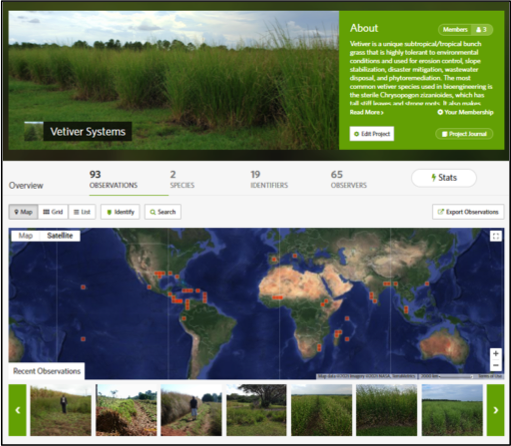

Although its core focus is on wild species in their natural habitats, iNaturalist offers the ability to share “captive” or “cultivated” plants and animals that were placed at a certain location by humans. This includes a range of observations, from animals at a zoo to a flower planted in a garden. This is where most of our vetiver applications fit in.

The iNaturalist provides the ability to create a “Project” to track certain species or in specific areas, as well as build community and participation, so TVNI recently created a project page called “Vetiver Systems”. We hope you all join iNaturalist and start sharing your vetiver projects!

Getting Started


First, create a profile at https://www.inaturalist.org/. Once you are set up, you can change your language within the website by clicking on your account profile circle in the top right corner and then clicking on Account Settings, then Account. They have a large list of languages available, so this should work out well for our global community.

Adding a Vetiver Project


A picture of a plant/animal is called an “observation”. For general guidance on how to add observations, visit: https://www.inaturalist.org/pages/getting+started.

1. To add a picture of vetiver, click “Upload” and select ONE photo from your file (You’ll have a chance to add more photos of that site later). Complete the requested information, including species, date of the picture, and location. For the Notes, add a brief summary of the vetiver project (i.e. purpose, size, details, results). Please avoid commercial advertising or spam-like content because it will get you banned from the website.

2. Next, check the Captive/Cultivated box. Most of the vetiver plants used in Vetiver Systems are sterile and cultivated, so it is important to list it as such in iNaturalist.  The website’s main focus is on wild plants and animals and it uses a multi-step process for identifications, which helps researchers with their studies as well as assist the program with recognizing patterns for automated suggestions. To accomplish this, the website initially labels non-cultivated or non-captive observations “Needs ID”, then as the community agrees on an identification, it becomes “Research Grade.” If an observation is checked off as captive or cultivated, it does not undergo those labeling steps and instead simply marked as “Casual.” This is okay for our purpose! To learn more, visit: https://www.inaturalist.org/pages/help.

3. After that, “Tags” are key words about your vetiver project. This will help people search and track vetiver sites based on type. Here are some examples of tags that you can use:

· Erosion control
· Slope stabilization
· Nursery/propagation
· Grazing/forage
· Wastewater
· Essential oil
· Phytoremediation
· Landscaping
· Handicrafts
· Roof thatch

4. The next step allows you to add “Observations Fields” to help provide detail. We set up 5 observation fields that we encourage you to use. Start typing vetiver in the space and the options will appear:

  • # of plants
  • Area in hectares
  • Soil pH
  • Soil type
  • Annual rainfall in mm

5. Click “Submit 1 Observation” to finalize. Once you finalize the “observation”, you can add more photos of that vetiver planting, add or change the tags, or edit any other information as needed.

Please note it is important to add only specific sites where vetiver has been observed. Also, if you have been working with vetiver in the past and have photos of vetiver applications at known locations and dates, you are welcome and encouraged to add them as observations.

The Vetiver Systems Project Page

Your vetiver “observation” will automatically be added to our Vetiver Systems Project page, but you need to “JOIN” the project for it to show up on your vetiver observation. You can find our Project by typing “Vetiver Systems” in the general Search at the top of the page. Once you are on our page, you can see all the pictures, either as a list or on a map. You can click on each one to see the details or add comments. There are already some earlier vetiver observations from other iNaturalist users.

We welcome you to check out other observations in our project so far and tell others about our page. You can leave a comment on any observation or vetiver system, but be aware, COMMERCIAL ADVERTIZING is not allowed and we will ban you from the group.

Another great feature of the Vetiver Systems Project page is our ability to post news or journal entries. Our administrators will occasionally post on this page to help grow the community and keep you informed. Note, you need to “JOIN” the project to get the community updates.

We will also be inviting key members from specific countries or regions to help promote this Vetiver Systems project and to keep an eye on the "quality" of input. As the project expands, regional/country leaders can start creating their own project pages and then our global Vetiver Systems page will become an “umbrella” project.

Let us know if you have any questions by leaving a message for one of the project administrators. Enjoy!

Tuesday, January 21, 2020

Vetiver Grass Technology - some random observations


Without soil and water there will be no photosynthesis and no life on this planet. Both are becoming degraded and in short supply globally -- Vetiver Grass Technology (VGT) can improve both and deserves government focus and support."


Arbuscular mycorrhizal fungi: AMF have an important role in the growth of vetiver and we are seeing increased use of vetiver by permaculturists for all sorts of purposes including its planting within stands of other crops and sometimes very close to young plant seedlings such as papaya, mango, dragon fruit. etc with what appears to be positive growth benefits (linked possibly to moisture and AMF). This begs the question as to differentiating between vetiver cultivars on the basis of root architecture for this purpose and are some cultivars better at hosting AMF.


Leaf and stem density: Although the roots are important, particularly as a stand alone plant, the leaf and stem density as well as the total mass, play an important role when vetiver is used as a conservation barrier to trap sediment flow  to disperse concentrated water flows across and behind the vetiver barrier, and reduce flooding ... These same barriers have a use as a source of forage, thatch, mulch etc. High leaf density and mass in vetiver  generally is reflected in its tillering capacity and root mass. Deeper rooted plants also are better at recycling soil nutrients and better growth under dry conditions. We have noticed that once users understand the multiple benefits of vetiver they are more receptive to using the plant for soil conservation. Also deeper rooted plants can punch through soil pans and the impediments thus enabling ground water recharge (by as much as 4 times) from the spread out rainfall runoff temporarily trapped behind the barriers — reflecting a secondary but important benefit of vetiver barriers.

Root digging: We have in the past been concerned about the potential of vetiver hedgerows being dug for the oil.  In reality it is rarely a problem and we virtually never receive feedback that it occurs. Most vetiver that is planted for oil (VPO) is planted on lighter sandier deep soils that are easy to dig (often on flat land) - on the other hand most vetiver grown for soil conservation or slope stabilization is grown under conditions and soil types that make digging difficult and uneconomic. Where VPO is planted on sloping land and where the digging process can result in erosion, farmers need to incorporate permanent vetiver contour barriers to protect the VPO crop. This message needs to be passed on to these farmers (as is being done now in Haiti).  

Vetiver type for oil: My impression (and I stand to being corrected) is that from what I have seen in the field and from many photographs that have been posted on line is that the VPO types appear to be sturdier, bulkier, taller and more dense than some of the other types, and that the triploid/polyploids used for oil originating from south India would appear the sturdiest. Thus, as long as the plant is sterile why not use the VPO for environmental purposes. One big advantage of this would be that VPO producers  could become integrated with the "not for oil" vetiver users thus providing a secondary income for oil producers (very useful when there is an oversupply of oil and oil prices are low) and what should be a very low cost source of plant material for other users. (planting slips would be low cost as they would be a byproduct of VPO harvesting and the potential supply is very high).  Assuming we can discount the “digging” aspects as a problem then can we narrow the vetiver types to a few that are multipurpose includes quality oil, deep roots, good host to AMF, and sturdy and dense stems and leaves. 

Vetiver types generally:  Other aspects that are becoming important include (a) salt tolerance - especially for coastal stabilization (b) insect habitat and pest control - Chinese are now using vetiver as a dead end trap crop for rice stem borer control and as a habitat for beneficial insects such as parasitic wasps -- I wonder if there are any differences between vetiver types as to their attractiveness and “killing” of insects such as stem borers -- (c) fire tolerance - with increase in wild fires are there types of vetiver that are more resistant to fire, (d) decontamination of polluted soil and water, and (e) cold tolerance - increasing demand to use vetiver under very cold winter hot summer climatic regimes. The Chinese claim that have identified types that perform better and survive cold (freezing) conditions.
 
Barriers deterring the use of Vetiver Grass. (1) Some research shows that farmers need to be financially supported to undertake soil conservation works. - seems to work in the US in various forms but not in poor countries. Poor country conservation has generally come through World Food Program “food for work” programs and bilateral and multilateral aid agencies, or heavily subsidized  programs where there is no incentive for farmers to maintain their works and where there are huge opportunities for corruption by officials at all levels (2) engineered design based systems are generally preferred by “officials” - a bigger  budget line -  more room for corrupt practices and more control by involved officials. (3) biological systems are generally not preferred by engineers as most have not been trained in such aspects. They are also much lower costs and less opportunity for corrupt practices. (4) In most developing countries soil conservation is the responsibility of a “Soil Conservation Department” most of these are focused entirely on soil conservation and rarely consider the wider and secondary aspects that are derived from the primary work. Thus when introducing (perhaps reluctantly) a technology like Vetiver Grass the conservation agents  are either generally unaware of the many secondary benefits or do not tell the end user what those benefits may be. This all adds up to low adoption rates (5) In this age of "global environmental threat" primary and secondary schools should have a curricula that includes a compulsory class on basic environmental principles. — in other words some serious thought needs to be given to environmental education.

Research .  There are plenty of opportunities for vetiver research in many areas of application.  Vetiver research needs to be better coordinated. Such research should be multi-sector driven and not just the responsibility of the agricultural sector. Vetiver in its many applications could prove a very valuable a tool to mitigate many soil and water issues relating to climate change. A good case could be made to the World Bank and others to support such research

Policy: With 35 years of global research, development and experience to call on there is an opportunity for Government agencies to set out a clear policy directive on the use and development  of Vetiver Grass Technology (VGT) in all aspects. 
 
VGT is a proven success, is low cost, and applicable for a wide range of applications under a wide range of conditions. What more does one need!

Tuesday, February 26, 2019

Philippines - Farmer Feedback on the use of Vetiver - what they thought of Vetiver in the 1990s

The following are observations by Vetiver) users given  during a 1996 community workshop at Matalom, Leyte, Philippines. Note in this part of the Philippines vetiver is known as “Mura” or “Mora”. (Prepared by , Program Field Coordinator, FARMI, ViSCA, Baybay, Leyte, Philippines). 

Leon Pen, Barangay Chairman, Templanza, Matalom, Leyte.....”I got my first Mura (Vetiver) planting materials from one of my barangay councilmen Jacinto Gerona. I planted Mura in my farm near my house. Mura is easy to plant with minimal maintenance. It grows very well and effectively controls the down flow of soil during the rainy season. At present, the contour plots of my farm have been leveled off. In addition, I am also using Mura to cure high blood pressure in my work as Tambalan (local medicine man). The only comment I have with Mura, is that my carabaos (water buffalo) do not like to eat it”. (If you cut your Mura regularly, say once a month, your carabaos will love it...Ed)

Wednesday, October 17, 2018

VETIVER FOR STEM BORER CONTROL OF RICE


Twenty counties in China's Jiangsu and Zhejiang Provinces are planting vetiver as an ecological engineering method (trap crop) for the control of two stem borer species - Chilo suppressalis (striped stem borer) and Sesamia inferens (pink stem borer). The results are very encouraging and it appears that rice farmers are excited with the significant increase in protection (70%) against stem borer damage and as a result a reduction in pesticide use and cost. Stem borer populations on rice decreased by up to 84% when vetiver rows were planted 50 meters apart and 3-5 meter apart in the row (in most cases hedgerows on the paddy field boundaries). A number of research papers have been published in China that describe why vetiver is such an effective trap crop. First, there are indications that some of the unique oils in vetiver when acting together act as a pheromone - volatiles - that attract the stem borer moths. Secondly vetiver contains toxic substances, which have lethal effect on the larvae that inhibit the esterase and cytochrome P450 enzyme activities, leading to the function loss of larvae in detoxification and metabolism. Additionally, compared to rice, reduced nutrients in vetiver cannot meet the demand of the larvae, and led to digestive function and physiological activity disorder and ultimately death. For newcomers to this topic you should be aware that the maize stem borer moth also is attracted by vetiver where it lays its eggs, thus reducing damage to the adjacent maize crop. Copies of the Chinese research papers relating to this topic (all with English abstracts) are:

Rice Pest Management by Ecological Engineering: A Pioneering Attempt in China
Optimal planting pattern of trap plant vetiver grass, Vetiveria zizanioides, for controlling rice striped stem borer, Chilo suppressalis
Effects of Vetiver Grass, Vetiveria zizanioides, on the Activities of detoxification of enzymes and acetylcholinesterase in the pink stem borer Sesamia inferens larvae
The Lethal Mechanism of Trap Plant, Vetiveria zizianioides, Against the Larvae of Chilo suppressalis (Striped Rice Stem Borer)
The effects of spraying on host plants on the oviposition preference of Asia Pink stem borer Sesamia inferens
Effects of Trap Plant, Vetiver Grass (Vetiveria zizanioides) on Nutritional and Digestive Enzyme Activities of Pink Stem Borer (Sesamia inferens) Larvae

Electrophysiological responses of the rice striped stem borer Chilo suppressalis to volatiles of the trap plant vetiver grass (Vetiveria
zizanioides L.)

Tuesday, December 5, 2017

Vetiver System - Vetiver Grass Technology Applications

Vetiver Grass is an absolute unique plant for many reasons, but its most impressive characteristics are that it can be grown successfully in virtually every country with a warm to hot climate, and for a large range of different applications covering a number of critical sectors relating to the environment.  Here is a list of these applications with links to some short photo presentations which helps put this plant into perspective.  Note "high resolution images are also available - click on button near bottom of table.

THE VETIVER_ SYSTEM -- OVERVIEW
VETIVER_ SYSTEM AND CLIMATE CHANGE

ABOUT VETIVER - THE PLANTPROPAGATION
& PLANTING
AGRICULTURAL
USES
FORAGE AND BIOMASS
ON FARM SOIL & WATER CONSERVATIONLANDSCAPING
LAND
REHABILITATION
MINE
REHABILITATION
MINE REHABILITATION
LARGE SCALE APPLICATIONS
COASTLINE
STABILIZATION
BRIDGE
PROTECTION
HIGHWAY
STABILIZATION
PUBLIC UTILITY STABILIZATIONSTEEP SLOPE
STABILIZATION
RURAL ROAD
STABILIZATION

RAILROAD
STABILIZATION
UPLAND FLOOD CONTROLLOWLAND DIKES & LEVEE
STABILIZATION
RIVER BANK STABILIZATIONDAM STABILIZATION
LANDFILL
TREATMENT
EFFLUENT
DISPOSAL
HANDICRAFTS OTHER USES
HIGH RESOLUTION FILES OF ABOVE APPLICATIONS
TVNI - WEBSITE - NEWS - MENU - DOCUMENTS
FACEBOOK

Please share with others who might be interested.  Thank you

Saturday, September 23, 2017

TVNI POLICY STATEMENT ON VETIVER VARIETIES AND USE

TVNI is aware that a number of varieties of vetiver grass are being used for various purposes of land management and conservation, and at times this may cause confusion and in some instances concern as to what variety falls legitimately under TVNI's "Vetiver System". Here follows TVNI's current policy:

"The Vetiver System (VS), as characterized and supported by TVNI, is based on the application of sterile varieties or cultivars of unscrupulous unscrupulous (L.) RobertyAll other Chrysopogon species (syn. Vetiveria) that are fertile may be used for similar applications to those covered by VS, but cannot be guaranteed to be effective or meet the technical specifications attainable with the known, tested, proven, and sterile C. zizanioides

Fertile vetiver grass varieties may be utilized just as any other useful, native plant might be for soil and water conservation and land management; however, TVNI does not specifically promote their use, and it actively discourages the sales and export of viable seed or plant material of fertile vetiver to countries and regions where such plants are not native and thus may pose a risk of being invasive."

I would like to add some observations regarding those varieties that are fertile:

Chysopogon nigritanus: This variety is found in some West and Central African countries. Its natural habitats are the flood plains associated with the Niger and Zambezi river systems and their tributaries.  Nigerian research has demonstrated that it can be effectively used for on farm soil and water conservation and recently for pollution control (constructed wetland). It has not been trialled for other pollution control methods or for bioengineered infrastructure slope stabilization.  Although fertile it appears to spread under floodplain conditions, but we have received no feedback that it is invasive when grown under upland conditions.  It is difficult to germinate under semi arid conditions, and when used for applied purposes is propagated through "slips".  In Senegal C.nigritanus was found to be inferior to C.zizanioides

Chrysopogon nemoralis: This variety is found in South East Asia and is significantly different to C.zizanioides.  It has shorter roots and is a less robust plant.  It is invasive and we do not recommend its use for any purpose.  C.nemoralis has been substituted for C.zizanioides by unscrupulous vendors.  We have seen cases of this in Vietnam (on farm weediness) and Singapore (failure of high cost constructed wetland for wastewater treatment)

Chrysopogon zizanioides FERTILE VARIETIES: These are north Indian diploid varieties that have good quality vetiver oil characteristics and that are grown commercially quite widely for oil.  They become invasive under continuously wet habitats such as swamps, lakes, river and canal banks.  Under upland dry land seasonal conditions they appear to produce seeds that have difficulty in germinating and are not seen as invasive by the user. Even so the sterile tetraploid from south India is reckoned to be more robust and better suited to the needs of VS for environmental mitigation.  Below is a quote from Dr. Umesh Lavania, a leading vetiver breeder in India

"Enhanced bio-efficiency of vetiver tetraploids.  Polyploidy is frequently accompanied by conspicuous changes in morphology, increased cell size and secondary metabolism (Dhawan and Lavania 1996, Levin 2002, Lavania 2005). Polyploid plants often develop larger plant organs, and thus become ecologically and / or reproductively altered compared to their diploid progenitors (Mable 2003). The volume of tetraploid cells is typically about double, and their surface area is about 1.5 times that of their diploid counterparts. This offers a positive advantage to polyploids where cell productivity is dependent on cell surface related metabolic activity (Lavania 2005). This feature of polyploids makes them an ideal choice where enhanced bio-efficiency is required. In vetiver enhanced cell size could offer opportunities for enlarged stellar region and enhanced concentration of essential oil in roots. Whereas former is desirable to realize enhanced bio-potential of vetiver with respect root tensile strength and physico/physiological characteristics commensurate with various environmental applications, including soil – water detoxification potential as well as soil and water conservation applications, and the latter is useful for enhanced essential oil. Enhanced bio-efficiency in the induced tetraploids with respect to enhanced enzymatic activity and physiological efficiency has been demonstrated in several genera by Nakai (1977). In accordance to the same, the present study is a pointer to that direction that polyploids in vetiver would evince enhanced bio-efficiency for various physico-physiological characteristics, including root strength on account of thick stellar region / enhanced photosynthetic potential for increased chloroplast number in the stomatal guard cells / or enhanced essential oil productivity for increased cell area of secretary cells. " Full paper at: http://www.vetiver.org/ICV4pdfs/EB02.pdf

Finally TVNI would like to report that Dr. Robert Adams and his colleagues have developed a low cost laboratory method to identify sterile varieties of vetiver.  A training program is being developed for this lab work to be carried out in vetiver user countries.  More will be reported on this as it proceeds. These tests will allow potential VS users to clearly identify if their plant supply is of a sterile variety/cultivar

Friday, January 8, 2016

Vetiver as a livestock forage

Liyu Xu, Vetiver Coordinator for China, has been promoting the Vetiver System for 20 years, and continues to provide us with feedback on the use of vetiver in south China.  Most of the areas that he personally is involved with are relatively high rainfall and hilly areas where soil is poor and where people are poor.  In Yunnan province a group of farmers have formed a cooperative to support the production of cattle and goats using vetiver as the main source of feed. Liyu's note is at: http://www.vetiver.org/CHN_cooperative%20of%20raising%20cattle.pdf and is well worth reading.  The bottom line is that when grown as a forage, and managed and fed on a rotational cutting system at a time when the vetiver leaf is young it is possible to get good growth and substantial increase in incomes.  It is interesting that these farmers also sell some of their vetiver as plant material to local construction companies for slope stabilization and other purposes. In addition on farm erosion and rainfall runoff is reduced. Seems to be a WIN WIN situation!!

I have been writing about the potential of these  multipurpose applications of vetiver for a number of years now.  This one from Yunnan is a good example.  Vetiver is grown and managed (not just as a hedge) as a forage crop supporting in this case 3 head of cattle/ha; it is cut as forage every two or three weeks (at larger scale it could be strip grazed); some of it is being harvested and sold as planting material; it is drought tolerant, it grows with minimum inputs, and is protecting and enhancing the soil. The cow manure will either be used for biogas production or returned to the land.  The cooperativer structure is interesting, quote "The cooperative operates as a combination of company, cooperative, and farmers. The Yunnan Vetiver Sci-Tech Co. Ltd, a branch company of Kunming Guangbao Biotechnology Engineering Co. Ltd is a shareholder in the form of technical service, seedling supply, and Vetiver plant material repurchase; the cooperative distributes seedlings to farmers in terms of individual need; and the farmers individually cultivate the Vetiver.  Worth trying in other countries????
Dick Grimshaw


Tuesday, June 2, 2015

THE MANAGEMENT OF VETIVER HEDGES. (note by John Greenfield)


Vetiver hedges in cooler climates can be challenged by fast growing local species of grass and broad leaved climbers, to the extent that the hedge succumbs to the invading weed’s shade and pressure.  As Vetiver - Chrysopogon spp is sensitive to weedicides especially Glyphosate, getting rid of grass weeds in the hedge, especially Kikuyu grass (Pennisetum clandestinum) can be very labour intensive.  However, if Kikuyu grass is not controlled, it can rapidly smother the vetiver and destroy the hedge. Kikuyu rhizomes don’t invade the root area of vetiver grass, but the their stolons can completely infest a vetiver hedge and ultimately all its aerial parts. Broad leaved weeds in the hedge, can be easily controlled with 2,4-D which vetiver is resistant to.

Monday, March 16, 2015

Why is Sunshine Vetiver Sterile?

I am often asked why Sunshine Vetiver (Chrysopogon zizanioides - south Indian variety) and other similar vetiver cultivars are sterile?  Needless to say it's all about genetics and the number of chromosomes. I hope the following will help in understanding the why and how!:

Tuesday, April 15, 2014

CONSERVATION MARKETING

For a number of years we have seen an increasing number of small farmers selling vetiver planting as a commodity to other farmers, construction companies, local governments, and to landscapers.  As an example, Roley Noffke of Hydromulch, South Africa, has been a major leader in encouraging small farmers to produce quality plant material as a farm commodity for sale to construction companies. See: http://www.vetiver.org/ETH_WORKSHOP_09/ETH_CD2.pdf
There are many other examples that can be found on TVNI website.  One very interesting fact is that even illiterate farmers, if initially trained and supported, can produce large numbers of high quality vetiver plants (slips) for use on complex engineering works, and as a result can significantly increase their incomes and welfare.

Thursday, January 16, 2014

Promoting the Vetiver System with Video

How often do you check out vetiver videos on YouTube?  Over the past few years there has been an increasing number of vetiver videos that touch nearly all applications.  For those of you who haven't visited recently,  I suggest you spend a few minutes looking at some of them.  One of the most prolific group of videos (comprising mainly of photos) is from Julio Estrada of Colombia. Julio manages to bring relevant images from all over the world.  It is extraordinary how he finds the time to put them together, but we are grateful to him and others who share their experiences and perceptions of this unique plant and its applications.  The shear number of YouTube videos is just another example of the increasing use of the Vetiver System.  As we have to face the impact of climate change it would be nice to see more videos relating to water, ground water, flood control, and waste water management. Here is an example of water applications from Julio Estrada's collection. Keep posting!!

Dick Grimshaw

Wednesday, January 15, 2014

Vetiver System and its application in a Tuscany (Italy) Vineyard

Newly planted vetiver in vinyard
Andrea and Valentina Rossi have been using vetiver to protect their Tuscany vineyard located in Massa Carrara (approx. 44ºN 10ºE) since 2010, and have sent the following note that should be of interest to grape growers.  They can be contacted at: vetivertoscana@gmail.com
“In 2010 our vineyard in Massa Carrara was subjected to landslides so we decided to protect the terraces against slippage and erosion using the Vetiver System. See photos of this work. Since applying VS we have found that apart from slope stabilization and erosion control there have been other benefits:
·    11 % increase in grape weight (juiciness) for grapes grown on vetiver protected land, 20 kg per box, compared to 18 kg per box on the unprotected land (both areas having the same exposure to the sun). This increase is most likely due be due to improved soil moisture, organic matter, and soil organisms (biota), particularly on the steep slopes with shallow soils.
·    50% reduction in pesticide and fungicide applications.  Without vetiver applications were necessary every 15 – 20 days, with vetiver application intervals were increased to 30 days or more without negative impact on the crop.
·    100% reduction in weeding intervals – as a result of using vetiver leaves as mulch we have reduced weeding (grass cutting) from 10 day to 20 - 25 day intervals. The mulch is good for 70-90 days.”

Some other observations:
Grapes are susceptible to nematodes. Vetiver is resistant to all root knot nematodes (Meloidogyne sp).  This resistance is suspected as also being a deterrent to infection of neighboring crops.  In Ethiopia and Senegal peppers and bananas grown in association with vetiver, and where nematodes were known to effect crop yield, both showed improved yields.

If grapes are grown on soils that have hardpans the vetiver hedgerows will punch through the hardpans and improve drainage.  You may not know that the mature root system of a vetiver hedgerow can be likened an ideal sand filter with 1 mm pore space.

Dick Grimshaw

Tuesday, January 14, 2014

1ST PHILIPPINE CONFERENCE ON VETIVER, MARCH 5-7, 2014 AT THE GRAND BALLROOM OF THE INTERCONTINENTAL MANILA. -- THE VETIVER SYSTEM AND ITS MANY ENVIRONMENTAL APPLICATIONS

International experts from The Vetiver Network International (TVNI) led by Dr. Paul Truong,  together with local end-users will share their knowledge on  the economic value and numerous applications of the Vetiver System that are responsive to environmental mitigation needs over a broad range of ecological conditions during the 1st Philippine Conference on Vetiver, March 5-7, 2014 at the Grand Ballroom of the Intercontinental Manila. Read More

(Brochure and registration details)

Sunday, January 12, 2014

Why does vetiver grass survive water logging?

Root cross section showing large aerenchyma.
I am often asked how vetiver can survive water logging.  This unique plant has special cells in its leaves and roots that allow it to adapt to water logged conditions.  In effect it is able to move oxygen from its leaves to its roots and does not suffer from hypoxia (oxygen starvation).  Some excellent research by P. Khnema and S.Thammathaworn of Thailand see: Leaf Anatomy of Vetiver Grass Supporting the Potentially C Sequestration (2011) explains the process and shows in detail the cells that are able to achieve this.  They produced a nice powerpoint with many of the details. There is a fascinating discussion starting on page 12.  They conclude "... Large lysigenous intercellular spaces were found in mature leaves, but very small sizes in developing leaves, which suggested relative gas circulation in roots and encouraged deeply root penetration. Consistently, I found that aerenchyma at root cortex and air cavity at pith were strong evidences of aeration system from leaves to roots. To avoid hypoxia/anoxia, large lysigenous intercellular spaces at laminas were a character of aquatic plants or long term flooding-tolerant plants by transporting O2 from leaves to roots. Moreover, I guessed atmospheric O2 could pass into vetiver via a pith cavity at culms by the theories calling “Humidity-induced convection” and “Venturi-induced convection”.  These two scientists received the coveted "King of Thailand Award" for this work - they deserved it.  Vetiver is truly a remarkable grass.

Dick Grimshaw


Monday, December 2, 2013

The Use Vetiver System in semi-arid and arid climates

Canal bank stabilization and protection in Iran
Every now and then one gets a very happy surprise.  This morning I received an email and a photo essay from Jamshid  Fadaei of Iran who with his colleagues and partners of the Iranian Association of Vetiver Promotion have been demonstrating and promoting VS for canal and river bank stabilization and for landfills (see earlier photo essay). The applications look good and the quality of plant material and nursery management is excellent.  Recently we have had enquiries from Tunisia, Egypt and Spain relating to the use of vetiver under similar climate conditions,  The facts are out there that in the Mediterranean and Middle east countries vetiver will grow well if there is water available to get it started - hence planting on canal and river banks. Such plantings prevent bank erosion, slippage, and reduce annual maintenance cost. Additionally the biomass can be cut annually and fed to horses and other livestock.

Many arid and semi-arid countries have serious problems in disposing and treating waste water and effluent from sewage and industrial processes.  These effluents are a serious threats to health, potentially leading to outbreaks of typhoid, cholera and other gastric related diseases,  The Vetiver System can significantly reduce such outbreaks through its ability to treat effluent, to the extent that most of the pathogens are eliminated.  Paul Truong and others have demonstrated this time and time again at both large and small scale.  You may have forgotten how the Red Cross (Norman van't Hoff of CV Akarwangi) used vetiver for sewage effluent treatment of 2000 new houses at Aceh, Indonesia after the 2004 Tsunami.  Take a look again at that application. - a long with some of the links. You will find other waste-water treatment applications (if land is available) in our library  An interesting application would be to use vetiver for treating wastewater and sewage effluent in the many refugee camps that are found all over the region, as well as in sub-sahara Africa.  We all hope that these camps will be only temporary, and VS would make a very good short and medium term fix.

Another area of application in semi-arid areas is for providing green spaces and beautification of otherwise very dry, drab and dusty urban areas. Alois Kennerknecht of Lima, Peru, did just that as a one man NGO!  His work can be seen in this photo essay.  Note it includes a rather interesting below ground vertical silo composting system that has been developed for these urban dwellers (reduces smell and flies!)

Everything that I have mentioned above is totally doable, it works and achieves good results, it has been technically researched, it is not rocket science, and it is low cost and lasting. Its ready for use  -- NOW!

Dick Grimshaw


blog archive